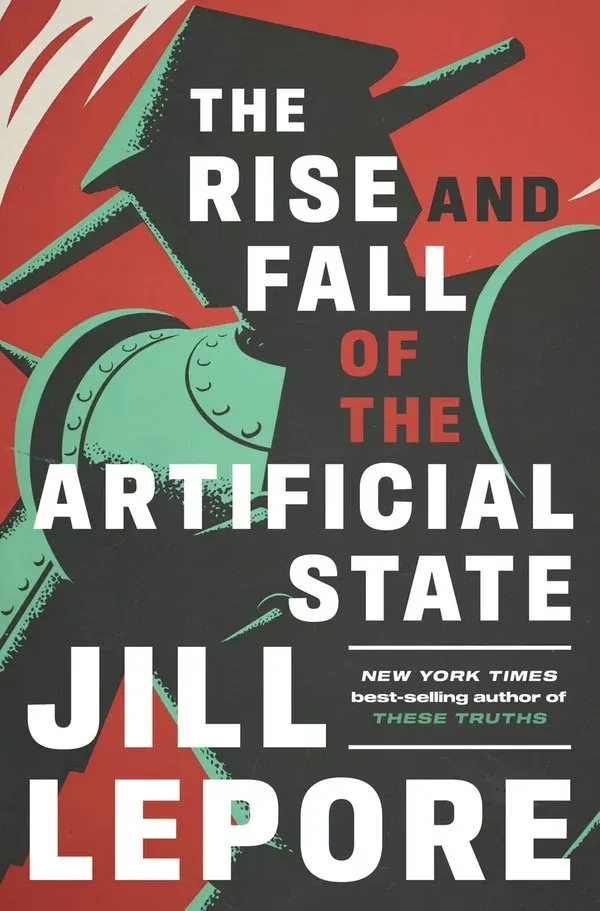
Read: The Rise and Fall of the Artificial State
Published Date: September 18, 2026This is a book review post, where I share my thoughts on something I’ve been reading lately.
I get most of my books from the local library using the Libby app, or from my local independent book store.
Introduction
About a month ago, I was listening to an episode of the Decoder podcast with Dr. Jill Lepore, a professor and author of a new book called The Rise and Fall of the Artificial State. I found the topics discussed in the episode to be quite interesting, so I put the upcoming book on hold at my local library. It was published on August 25, and my hold became available just in time for Labor Day weekend.
Summary
In The Rise and Fall of the Artificial State, Lepore defines the artificial state as both a dream and a reality, already alive and developing in the United States. The dream is a future where humans are no longer bound by physical constraints, such as our bodies, relationships, or environments. The reality is “a successor to the liberal nation-state” in the form of “government without consent, even government without humans”, enabled by algorithms – and the corporations that build them – that diminish or replace human contributions.
Lepore documents how this artificial state came to be built, tracing how technologies originally built for state operations came to be repurposed – in corporations and on civilians – in service of efficiency and greed. Tabulating machines were originally developed to speed up data collection and processing for the 1890 U.S. Census, later used by the Nazis to identify and persecute Jews and other people deemed “undesireable”. This quantification of humans and their behavior is what enabled Big Tech companies to make buckets of money serving targeted ads to their users.
In addition to technological changes, the artificial state was built on ignorance: its inventors misreading twentieth century science fiction and dismissing contributions from the humanities. But just as the artificial state was built, so too can it be dismantled. Lepore ends with a cautious hope that this reality is not inevitable, and that we the people still hold the power to create a better future.
Review
Rating: 4 out of 5
The book starts out strong, with Lepore setting what felt like a marching pace to hook in the reader. The prose is quite readable and provides the right level of detail to set context without being overwhelming. I found Lepore’s historical record of how we got here to be both interesting and informative – the Technocracy movement was completely new to me, despite my American public school education. In the middle of the book, Lepore covers some philosophical theories on humans versus animals versus machines, which didn’t quite land for me. Though most of the book is discouraging, Lepore does try to end on a positive note, signing off with the academic, professional equivalent of “go touch grass”.
Here is one of my favorite quotes from the book:
“Having dismissed philosophy, history, literature, and every humanistic way of learning, thinking, and knowing, including the very act of reading, and hoping for a future in which the work of reading was to be done by machines, perhaps the architects of the Artificial State no longer knew, as humans, how to search for meaning in a text.”
If you’re interested in understanding systems and reading history, you are likely to enjoy this book.